 Index Page
SITE MAP

In view of the revised FIT from 2016 this page will only remain active until the middle of the year
| Index Page |
SITE MAP |
Next Page : What's new
|
October 2011 Because of the government much reduced payment scheme this page has had to be drastically revised
This solar panels cost comparison site offers information to get three quotes anywhere in the UK.
For information of the Feed in Tariff you would get if you install a PV (Photovoltaic) system on your roof see http://www.energysavingtrust.org.uk/Generating-energy/Getting-money-back/Feed-In-Tariffs-scheme-FITs#rates
A report October 2015 The estimated cost of solar panels on a large 7 x 4 metre area is now around £6000 plus around £500 for fitting and connecting to your supply. Until the end of 2015 the tariff would have enabled you to pay this off in savings in about ten years and the following ten years would have resulted in savings of around the same (£6000 or so). However, as I mentioned below, the government set the feed in tariff (FIT) and length it would paid at an over- generous level. This will be reduced and will mean that it would take at least 25 years to even pay off the cost. This effectively means that the scheme is dead. If they have an energy efficiency level of D and above they could still qualify for a FIT of as much as 12.47p per kWh but below D this would be reduced to 5.94p
Since the initial over-generous scheme commenced in 2010 the FIT has been considerably reduced and the promise to pay has come down from 25 years to 20. In addition, the efficiency of a system is taken into account. So far, a quarter of a million installations have been agreed - 99% of which are PV type. Even since the lower rate has been announced there has been a rush to install with 100,000 new systems between January and March 2012
The hastily produced government reports contain obvious errors, one stating that the new rate would be paid from December 1012 (!!) and the attached extract from the Energy Savings Trust also contains an obvious error, which we have to assume is 2013. So, I do hope you can make something of the tariffs. Although installations were increasing at an exponential rate I somehow doubt that this will continue at the same rate. And, like the latest idea of cladding the outside of old houses, not much thought is given to the LOOK of a property.
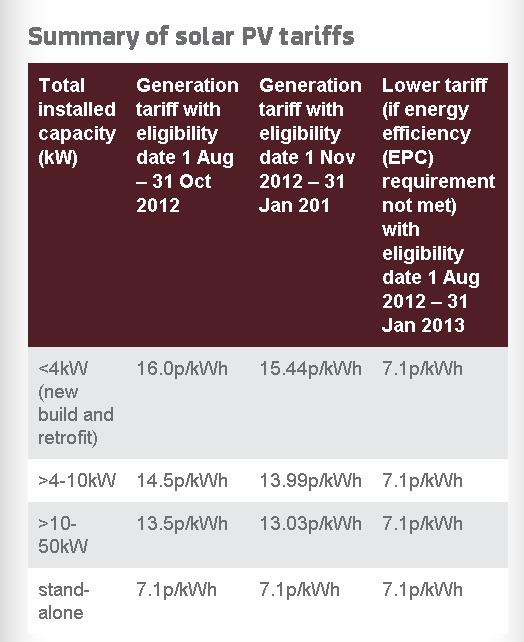
http://www.energysavingtrust.org.uk/Generate-your-own-energy This page does NOT deal with solar water heating, which is currently not as generously subsidised by the government - see below.
http://ashadegreener.co.uk/energy-study/ has some interesting figures which show the average savings on electricity bills (regardless of any FIT payments)
Even at the lower rate the scheme would still have paid the tax free and inflation proofed FIT (Feed In Tariff) for 20 years, so it would have still been attractive to higher tax payers and people who wish to be environmentally friendly, especially as energy costs continue to rise and 2015 is expected to be a crisis year as coal fired stations are closed down all over Europe.
I have a feeling that many people will continue to install panels, just as
they may buy fair trade bananas or other 'world friendly' deals. Yes,
the payback will take longer but it is still a payback (unlike
money in a bank). The earlier FIT tariff was altogether too generous and
will continue to pay the well-off at the expense of the rest.
And who is paying for all this ? Er... YOU ARE ! Because
the cost is spread between the electricity companies, who pass it on to
customers.
Solar energy in most parts of the world is used for heating water. But government grants for renewable water heating installations are comparatively poor. In fact, in most cases, they will only be given for equipment in houses NOT heated by mains gas (because other forms of heating: (coal, oil, wood and electricity) produce more carbon than mains gas, and the aim is to reduce the amount of carbon produced . However a one-off grant of £300 may be awarded for a solar heated hot water system.
If you are still interested what are the rules ?
You need a large
roughly south-facing sloping roof (25 - 45 degrees)
with suitable 12 - 30 square metres (as much as 10ft by 22ft) and most companies
say you need to be south of Newcastle on Tyne. If your roof is facing
East or West it would be at least 15% less effective but, nevertheless it
would work during daylight.
Planning permission is not generally required as long as the installation
does not protrude more than 200mm above the roof line. See
www.planningportal.gov.uk
But you are unlikely to get permission for a listed building or in a conservation
area.
You financially gain in two ways: (Now outdated)
(1) The electricity that is fed into the power grid, for which your electricity
company will pay you around 21p per kilowatt hour (kWh) - which is more than
you pay your power company now.
(2) Plus a smaller amount for electricity which you generate for your own
use.
(3) AND you save again by reducing your electricity bills.
The Energy Saving Trust has cut its estimate of a typical home's annual savings to £70/year, as its research shows more electricity goes back to the grid than previously thought See Calculator http://www.energysavingtrust.org.uk/Generate-your-own-energy/Cashback-Calculator
You may even get your panels installed free by some companies but with free panels you don't keep 'feed-in' tariff. The company fits panels but they then keep the feed-in gain. You just keep the electricity saving, though prices are predicted to rise massively over 20 years, so the saving could increase. But leasing your roof to a company could add complications when you come to sell (or move on for other reasons!)
** These 'free' schemes are likely to have dried up because they are no longer so profitable for the companies
Rules if a company supplies panels : The company should provide the consumer with
The full value of the expected feed in tariff income over 20 years.
The up-front cost of the system to be installed i it is to be purchased outright
The up-front cost of the system if purchased with a loan
Whether the consumer will receive the 'export premium'
Whether the consumer will receive the FIT once the capital cost has been paid
Legal ownership of the system
Arrangements for maintaining and insuring the system
The status of the manufacturer's and installer's guarantees
Implications for the consumer's mortgage
Whether the consumer can purchase at a later date
Who will be responsible for removing the system at a later date
Arrangements if the property changes hands
Arrangements for the termination of the agreement
Full list of fitters & free panel companies in the Updated Guide "Free" panels: http://www.moneysavingexpert.com/utilities/free-solar-panels#free
For purchased panels see http://www.moneysavingexpert.com/utilities/free-solar-panels#youpay. Note that most want an area of around 24m2. That is no small area. In old money that would be at least 10 foot by 22 foot. For people who are prepared the pay more it is even possible to have panels in tile form
See also : MoneySavingsExpert Solar Panels Related: Cheap Gas & Electricity, Energy Grants
| Index Page |
Top of Page | Next
Page |